It starts with a first experience
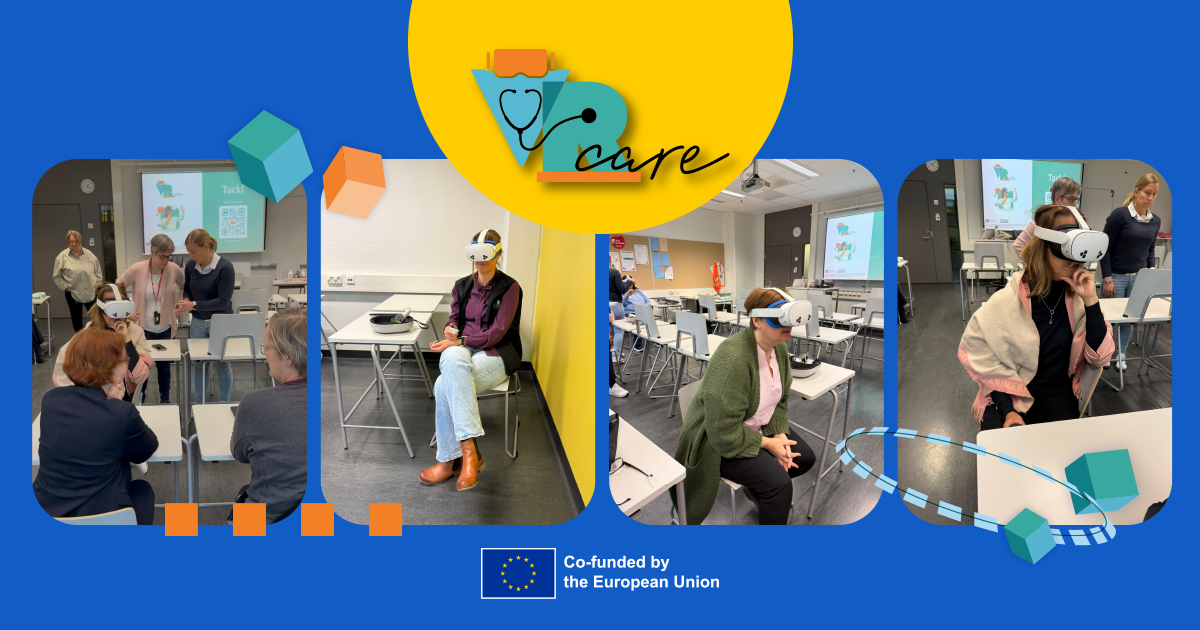
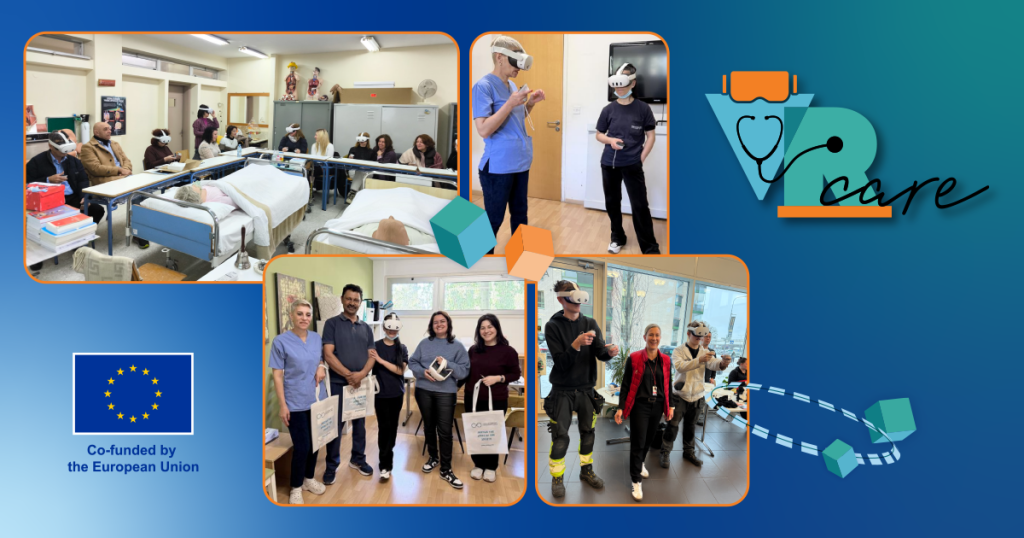
For many of the 235 participants in the VR Care pilot, this was their very first time putting on a VR headset. Coming from Finland, Denmark, Ireland, Spain, Greece and Cyprus, they stepped into something unfamiliar, unsure of what to expect, but curious about what it might offer.
What followed was not just a demonstration of new technology, but an experience that felt surprisingly real. “You feel inside the situation they are putting you in,” one participant reflected.
This reaction was not unusual. Again and again, participants described the same moment of transition – from observer to participant, from watching to experiencing.
At the heart of this experience is VRCare, an Erasmus+ KA220 project co-funded by the European Union through the Finnish National Agency EDUFI. The project represents an innovative approach in which teachers and healthcare practitioners co-create real-life scenarios that are brought into virtual reality, particularly in the fields of childcare and elderly care. Moving beyond traditional teaching methods, VRCare offers immersive, interactive, and ethically grounded learning experiences that enhance engagement, stimulate reflection, and deepen practical understanding.
When learning stops being theoretical
In traditional learning environments, difficult situations are often discussed, analysed, and reflected upon from a distance. In VR, something different happens. The learner is no longer outside the situation—they are in it.
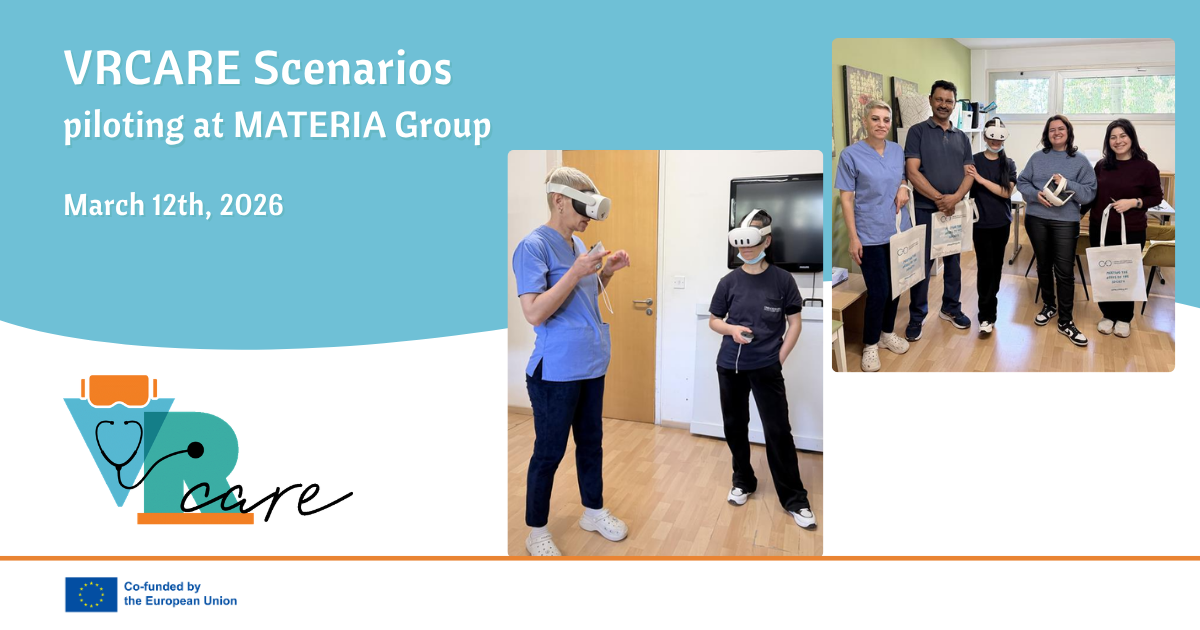
In the VRCare pilots, participants found themselves standing in care settings, navigating conversations, making decisions, and responding in real time. Scenarios around childcare, elderly care and ethical challenges became more than examples, they became experiences. “It feels more real than just discussing situations,” one participant noted.
This shift matters. When learning becomes experiential, it becomes memorable. It becomes personal. And most importantly, it becomes transferable to real-world practice.
A space where it’s safe to learn
One of the most powerful aspects of the VR pilots was something simple but essential: the freedom to make mistakes.
Participants repeatedly highlighted how valuable it was to practise in a safe environment, especially when dealing with sensitive or complex situations. Whether navigating end-of-life care or managing challenging behaviour, the scenarios allowed them to try, reflect, and try again – without real-world consequences. “I enjoyed that I could practise safely without worrying about making a mistake,” one learner shared.
For the students, teachers and caregivers, this sense of safety is not just reassuring, it is what makes deeper learning possible.
Confidence begins before the real world
As participants moved through the scenarios, something else began to emerge: confidence.
Not the confidence that comes from theory alone, but the kind that develops through experience. The kind that grows when you have already faced a situation, albeit virtually, and worked through how to respond.
“VR is an excellent way to build confidence before real-world practice,” one participant explained.
For teachers, this opens new possibilities in preparing students. For students, it offers a way to strengthen skills before stepping into complex, real-life situations. For care-givers, it gave them an opportunity to review and re-think their actions.
Designed together – Learned together
What makes the VR care scenarios developed within the Erasmus+ KA220 project particularly meaningful is how the VR scenarios were created and piloted. These are not scenarios designed in isolation, but developed and piloted in collaboration with students, teachers and healthcare practitioners, many of whom were new to VR themselves.
This shared starting point shaped the process. It meant that the pilot was not just about testing scenarios, but about learning how to create and improve them – together.
In this context, the feedback from participants became essential. The insights gathered across countries helped identify what works, what resonates, and what can be strengthened.
The contribution from Denmark, in particular, stood out. With more familiarity with VR, Danish participants offered detailed and constructive suggestions that will be invaluable in refining the scenarios. Their input helps bridge the gap between first experimentation and future development.
What we learned along the way
Perhaps one of the most important insights from the pilot is this: immersive learning does not require prior experience to be effective.
Even those completely new to VR were able to engage quickly and meaningfully. The technology, when thoughtfully designed, did not become a barrier – it became a bridge.
Participants in the pilots also showed clearly that immersion matters. The more realistic and engaging the experience, the more impactful the learning. When learners feel present, they respond more naturally, reflect more deeply, and remember more clearly.
And there was another message, repeated in different ways across responses: this should not be a one-off experience. There is a clear appetite for more: more scenarios, more opportunities, more integration into everyday learning and training.
Looking ahead: deepening the experience
The next step is not to start over, but to build on what has already been learned. Our next six scenarios, that will be piloted in November – December 2026 will aim to deepen the sense of participation, allowing users to take a more active role in shaping outcomes. Interactions will become more natural, experiences more dynamic, and scenarios more varied.
At the same time, one thing will remain central: accessibility. The experience must continue to work not only for experienced users, but for those putting on a VR headset for the very first time.
A glimpse of the future of learning
The VRCare pilot offered a glimpse into what learning can become.
It showed that training does not have to be confined to classrooms or textbooks. It can be immersive, experiential, and deeply engaging and fun. It can allow learners to step into situations, to feel them, to respond to them, and to carry that understanding forward into real life.
Most importantly, it shows that meaningful innovation does not happen in isolation. It happens through collaboration, through feedback, and through a willingness to learn from the process. What began as a pilot has become something more: a foundation for a new way of learning in education and care.