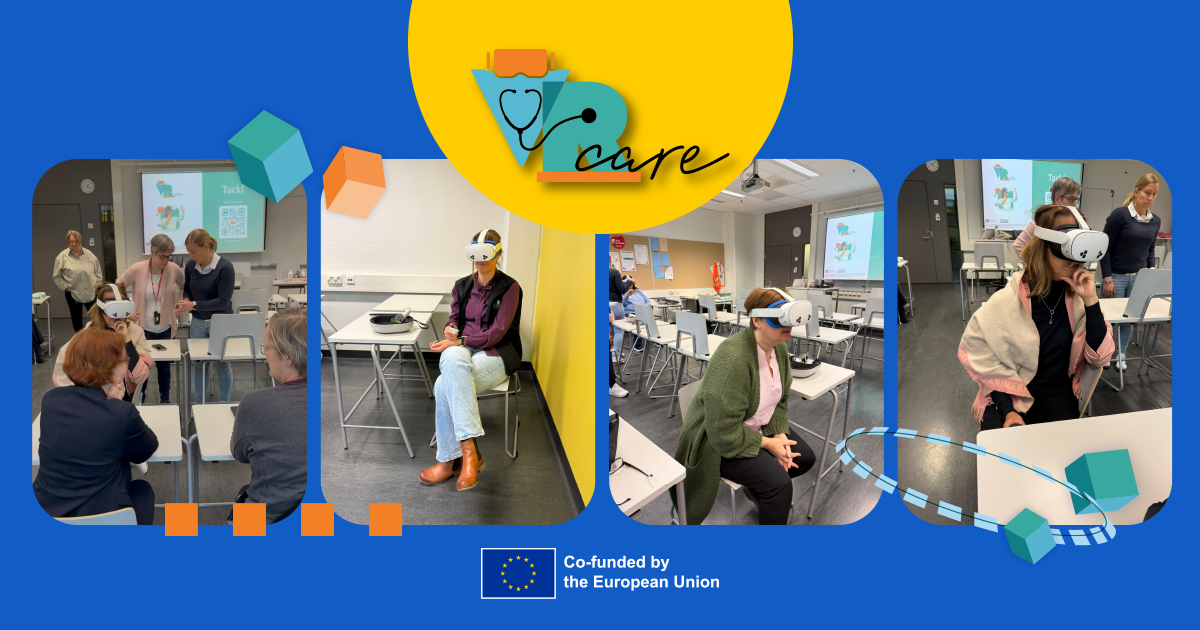
In late September 2025, the project partners from Finland, Greece, Denmark, the UK, Spain, Ireland and Cyprus, gathered in Denmark for the second transnational VRCARE project meeting. VRCARE, an Erasmus+ KA220 (VET) project funded by the European Commission through the Finnish National Agency EDUFI, is pioneering the integration of Virtual Reality (VR) into social- and healthcare education focusing on elderly and childcare. The aim is to create immersive, empathetic, and practical learning environments that bridge theory and real-world application.
What we’ve achieved so far
Over the course of the meeting, the partners explored how VR can transform training for both students and professionals in elderly and childcare. The team at SOSU Ostjylland (Denmark) demonstrated how VR is already being used by them to simulate realistic medical and care scenarios allowing learners to practice procedures safely, refine ergonomic techniques, and engage emotionally with the experience.
Participants tested and got trained in using MetaQuest3 goggles, experiencing firsthand how virtual environments can be used to train decision-making, empathy, and teamwork. This hands-on engagement helped refine the learning design: clear learning objectives, realistic scripts, and reflective debriefs were identified as critical components to ensure that VR isn’t just “a game,” but a genuine educational tool.
Before the meeting 36 pedagogical real-life scripts had been written by the partners representing VET providers and out of these 6 had been transformed into original VR scenarios (3 focused on elderly care and 3 on childcare) by p-consulting.gr (Greece). The focus on these scripts and dilemmas was on ethical dilemmas that students are likely to encounter when entering work-based learning in nursing homes and kindergartens. The scenarios were tailored to local cultures, traditions, and languages, ensuring relevance and inclusiveness across Europe.
Next steps: From development to piloting
We are about to step into our next phase, which is both ambitious and exciting. By October 22, the project framework and translations will be finalized, minor changes will be added to the scripts and VR scenarios which will then be followed by testing between January and March 2026.
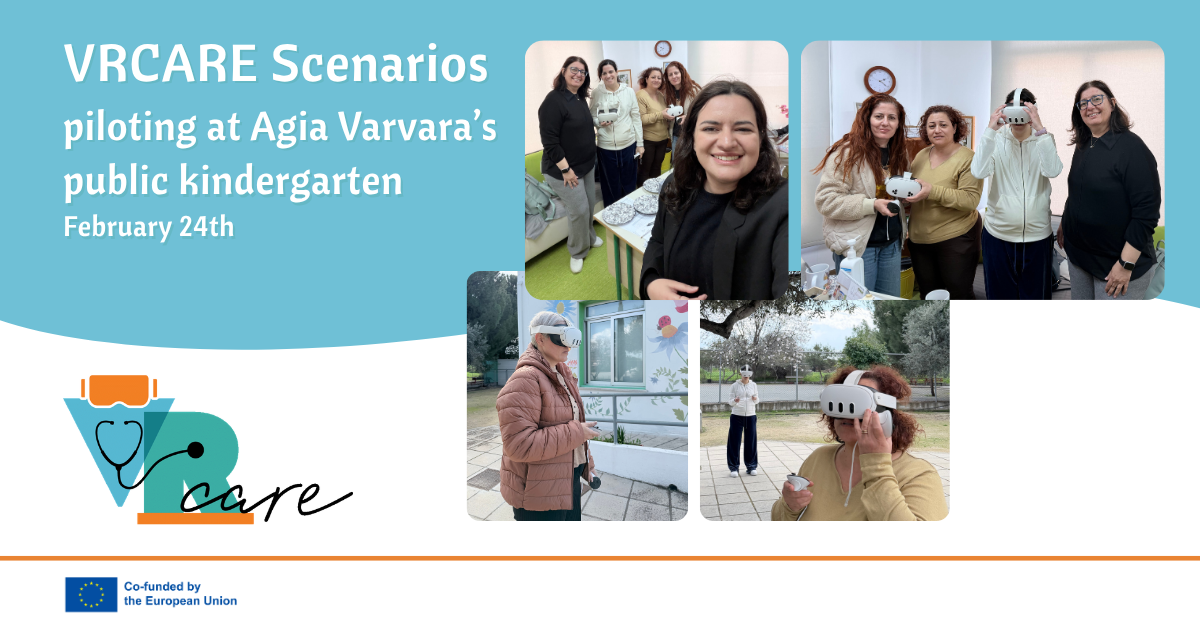
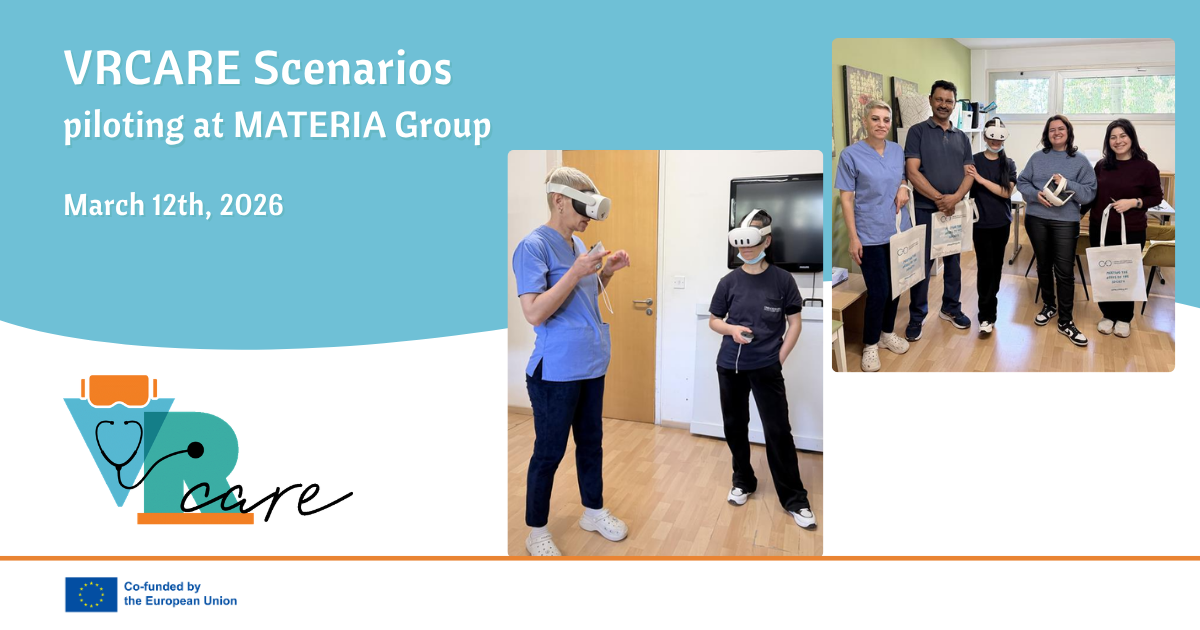
The piloting phase will involve 12–18 students per country, alongside teachers and associated partners. During this stage, participants will experience the VR scenarios in real educational settings, while comprehensive evaluations will collect data on usability, engagement, and learning outcomes.
The piloting and testing phase will be a key moment to assess how VR impacts learning motivation, ethics, empathy development, and confidence in real-world caregiving.
What we hope to gain as the pilots begin
Even before it has begun, the piloting phase promises significant benefits. Based on our small-scale internal training and pilot session held during the meeting in Denmark, we could already recognise several promising outcomes and long-term impacts of the scripts and scenarios. The participants in the training reported increased engagement, stronger emotional connection, and a greater sense of confidence in applying practical and interpersonal skills. They also predicted that the pilots will:
- Enhance engagement and motivation as students will actively “learn by doing,” fostering deeper retention and enthusiasm.
- Provide safe practice environments where learners can make mistakes, reflect, and improve without risk to real patients or children.
- Support teacher empowerment as teachers will gain digital confidence, new pedagogical tools, and innovative ways to connect theory with practice.
- Encourage cross-cultural learning through shared European scenarios that will build intercultural understanding.
- Provide us with real-time feedback loops as data from pilot evaluations will guide improvements in scenario design and technical development.
What’s Next?
Already during the meeting, the participants began to work on the next 36 real-life scripts. These scripts will be designed to activate and inspire elderly and children by using real-life scripts and VR and help them relive meaningful moments, experience joy, and feel connected and included.
For elderly care, the scenarios will transport users into familiar and emotionally rich environments, from re-learning songs from their youth to visiting monuments and museums, cooking traditional recipes, or enjoying virtual walks in nature.
For childcare, the focus will be on playful learning and interaction — encouraging curiosity, creativity, and social engagement through relatable, everyday activities such as choosing clothes to wear, brushing teeth morning/night, socialising in the playground and visiting a farm or a zoo
These scripts will form the foundation of the 6 upcoming VR scenarios that will be first piloted during the 3rd transnational meeting in Patras, Greece end of September 2025, and after that on students, teachers, care givers, children and elderly in care settings. The aim is to test not only technical and educational quality but also emotional and social impact.
A Vision for the Future
VRCARE is not only about technology, it’s about humanity. By merging empathy, ethical reflection, and digital innovation, this project is redefining how we train future caregivers and teachers. As the piloting phase begins, we stand on the threshold of a new era in vocational learning, one where immersive experience help shape more compassionate, skilled, and adaptable professionals across Europe.
For more information visit our website: home page – VR Care